


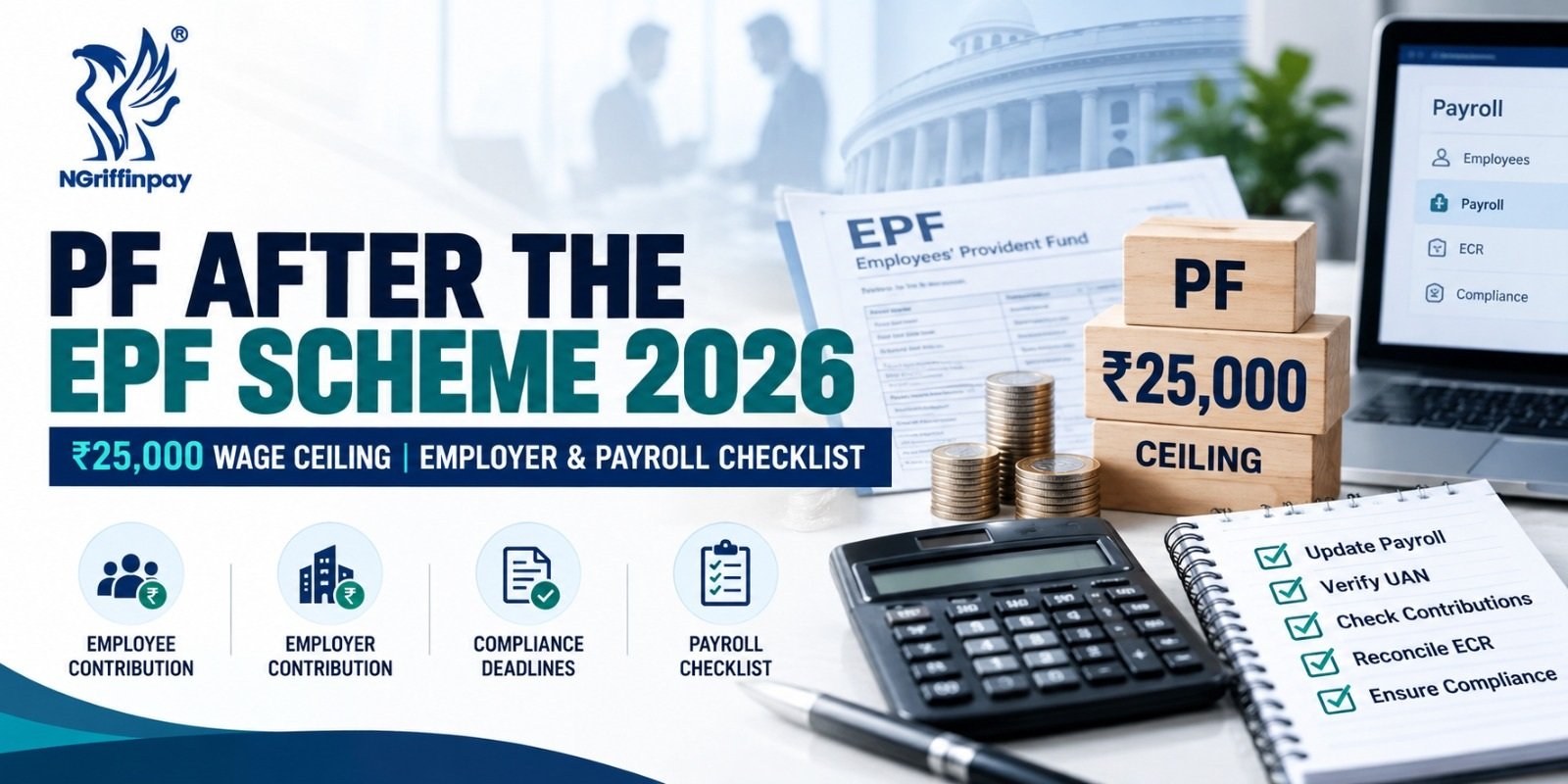
PF After the EPF Scheme 2026 and the ₹25,000 Ceiling: What Every Employer and Payroll Team Must Do
Provident Fund compliance has been rewritten twice in 2026. First, the Employees' Provident Funds Scheme, 2026 (notified 29 June 2026 as G.S.R. 525(E)) replaced the 1952 Scheme under Section 15(1)(a) of the Code on Social Security, 2020. Then on 17 September 2026 the statutory wage ceiling rose from ₹15,000 to ₹25,000. This blog pulls both changes into a single working guide.
```html1. What the EPF Scheme 2026 changed
- New legal basis. The Scheme now sits under the Code on Social Security. Actions taken under the 1952 Scheme are preserved, so past filings and memberships are not reset.
- UAN-first compliance. Employers must ensure a UAN exists for every employee who lacks one and must help employees reach their e-passbook. Nominations are electronic and can be updated online.
- Mandatory e-nomination. A fresh nomination is needed after marriage. Existing paper nominations remain valid.
- Contribution rate. Mandatory contribution stays at 12% of basic wages plus DA (10% where concessional rates apply).
- Voluntary PF (VPF). Employees may contribute up to 100% of basic plus DA. The employer is not obliged to match the excess, and the employee can revise the voluntary percentage once per financial year.
- Wages above the ceiling. Contribution on full wages above the ceiling is possible through a joint request by employee and employer, with the excess treated as voluntary.
- Interest. The Central Board of Trustees recommended 8.25% for FY 2025-26, subject to approval and crediting.
2. The ₹25,000 ceiling: the numbers
| Item | Before 17 Sept 2026 | From 17 Sept 2026 |
|---|---|---|
| Statutory wage ceiling | ₹15,000 | ₹25,000 |
| Maximum mandatory employee PF (12%) | ₹1,800 | ₹3,000 |
| Maximum mandatory employer PF (12%) | ₹1,800 | ₹3,000 |
The ₹3,000 figure is simply 12% of ₹25,000. How the employer's 12% splits between EPS and EPF at the new ceiling (8.33% of ₹25,000 would be about ₹2,083 to EPS) should be confirmed against EPFO's FAQs [verify].
September 2026 is a split month. Compute 1–16 September on the ₹15,000 ceiling and 17–30 September on ₹25,000, and file one ECR. If the extra employee share could not be deducted from September pay, recovery can be deferred to the next payroll.
Worked example
An employee has PF wages of ₹30,000 (basic plus DA) and contribution is restricted to the ceiling. For 1–16 September (16 days), the base is ₹15,000 and for 17–30 September (14 days), the base is ₹25,000. A simple day-weighted illustration:
(15,000 × 16/30) + (25,000 × 14/30) = 8,000 + 11,666.67 = ₹19,666.67 of PF wage, so 12% is about ₹2,360.
EPFO's FAQs or your PF consultant should confirm the exact rounding method [verify].
3. Who is newly affected
Employees earning ₹15,001–₹25,000 can now fall under mandatory coverage, which the government says could add over 51 lakh employees. The Employees' Enrolment Campaign 2026 also lets employers enrol employees who joined between 1 April 2009 and 31 March 2026 and were never enrolled. Employers can claim incentives under PM-VBRY, which EPFO has pointed to as an offset for the added cost (enrolment valid till 31 July 2027).
Take-home impact
An employee in the ₹15,000–₹25,000 band will see lower net pay, and so will anyone whose structure moves to the new base. Warn them before the payslip, not after.
4. Deadlines and money rules
- ECR: upload monthly data within 15 days after month close. September 2026 is due 15 October 2026.
- Claims: scrutiny and forwarding within 5 days, settlement within 20 days by the Commissioner. All withdrawal, advance and transfer claims are electronic.
- Partial withdrawal: after 12 months' continuous membership, up to the eligible balance (total contributions plus interest less a mandatory 25% minimum), with a minimum ₹1,000 per application. On ₹8,00,000, the eligible amount is ₹6,00,000.
- Damages on late remittance: as reported, 0.25% per month where default is under two months, 0.50% for two to four months, and 1.00% beyond four months [verify against the Scheme text, since earlier regimes used different bands].
- Contract labour: where the contractor is not separately registered, the principal employer must deposit both shares and charges within 15 days after month close.
- Settlement window: Vishwas 2026 is a one-time settlement for employer defaults generally up to 14 June 2024. Ask your advisor whether you have legacy exposure.
5. EPS after age 58
Payroll must treat EPF and EPS differently for employees past the applicable pension age. Check how your system handles this before it generates a wrong ECR.
6. Payroll checklist
- Change the PF wage cap in the payroll master to ₹25,000 effective 17.09.2026.
- Run a band report of employees with PF wages between ₹15,001 and ₹25,000.
- Verify UAN, name, DOB and joining date against EPFO records. ECR validation is more system-driven now, so mismatches get flagged.
- Reconcile payroll, ECR and challan every month.
- Update offer letter, CTC template and PF policy.
- Decide your policy on VPF and wages above the ceiling, and document it.
Keep an audit trail of every correction.
Frequently Asked Questions About the EPF Scheme 2026
The Scheme updates EPF administration, including UAN management, electronic nominations, e-passbook access and voluntary PF contributions.
At a 12% contribution rate, ₹25,000 in PF wages results in ₹3,000 each for the employee and employer, subject to applicable EPFO rules.
Employers generally must remit contributions within 15 days after the month ends. Late payment may attract statutory damages and interest.
Verify UAN details, apply correct contribution rates, reconcile payroll with ECR and challans, update nominations and maintain compliance records.
Conclusion
PF has moved from a rule you set once to a data-quality discipline. Clean UAN data, a correct ceiling and a monthly reconciliation will prevent nearly every notice.