


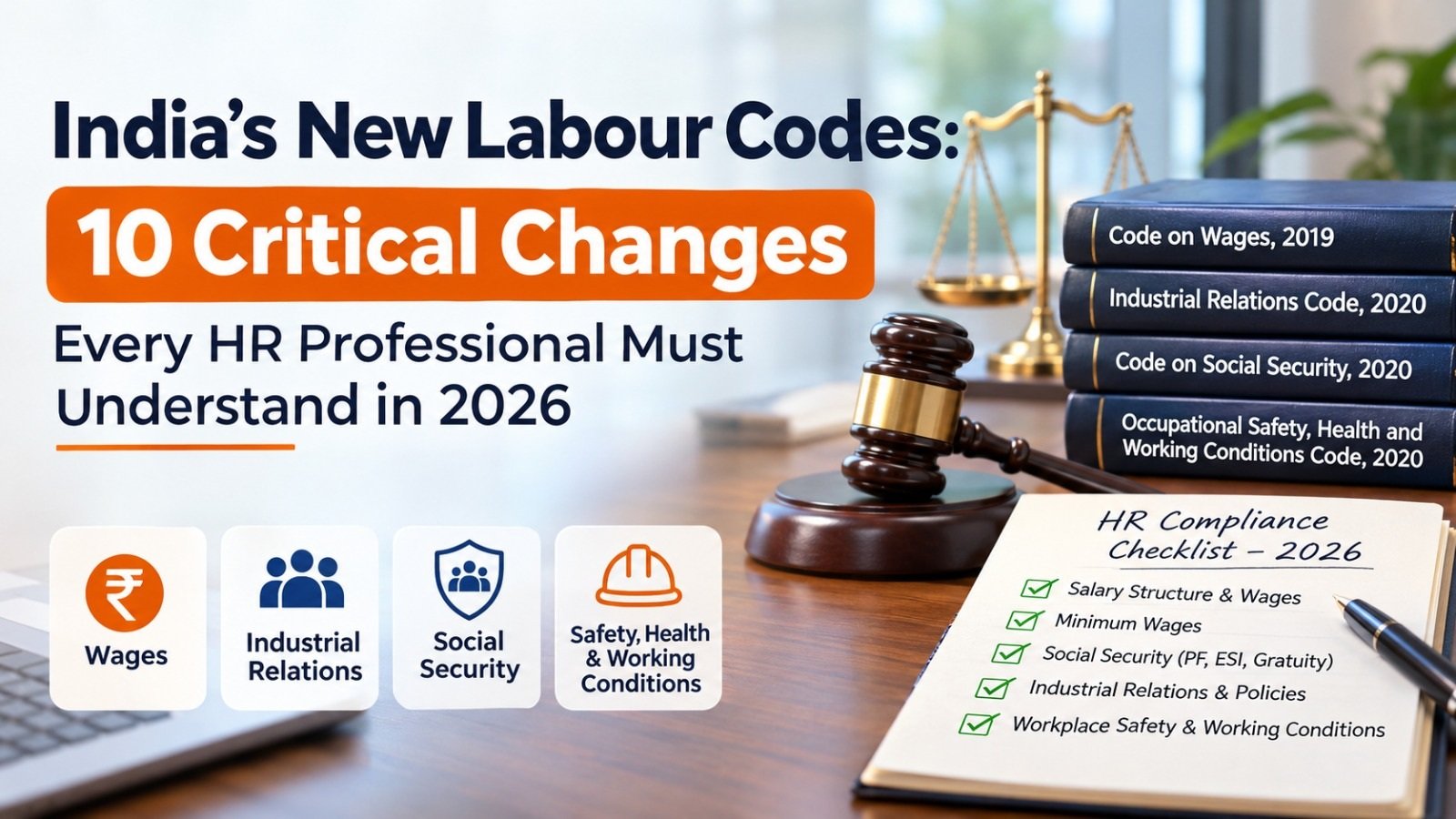
New Labour Codes in India 2026: 10 Key Changes for Employers and HR Teams
India's labour and employment landscape is undergoing a significant transformation. Employers that previously managed multiple central labour laws through separate registers, payroll calculations and compliance processes must now assess their obligations under a consolidated legislative framework.
Introduction: Why 2026 Is a Critical Year for HR Compliance
The four Labour Codes cover wages, industrial relations, social security, and occupational safety, health and working conditions. Their implementation represents a major change in how organisations must approach employee compensation, statutory benefits, employment documentation and workplace compliance.
For HR professionals, the challenge is not simply understanding the legislation. The real challenge is translating the legal requirements into practical policies, payroll configurations, employee communication and auditable processes.
A company may have an experienced HR team, a payroll executive and an external compliance consultant and still face gaps if its salary structure, employee records and statutory filings are not aligned.
The priority for employers in 2026 should be to assess the applicable provisions, identify gaps and implement a documented compliance framework.
1. Understanding the Four Labour Codes
The four Labour Codes are:
A. Code on Wages, 2019
This Code addresses minimum wages, payment of wages, bonus-related provisions and equal remuneration principles.
Employers should assess:
- Whether employees receive at least the applicable minimum wages.
- Whether wages are paid within the prescribed timelines.
- Whether salary components are classified correctly.
- Whether overtime and other applicable wage payments are calculated correctly.
- Whether payroll records support the amounts paid to employees.
B. Industrial Relations Code, 2020
This Code covers industrial relations, trade unions, standing orders and provisions relating to industrial disputes.
Employers should review their disciplinary procedures, employment documentation, grievance-handling mechanisms and applicable standing order requirements.
Organisations operating factories or employing larger workforces should pay particular attention to the provisions applicable to their establishment and workforce size.
C. Code on Social Security, 2020
This Code consolidates provisions concerning social security, including provident fund, employees' state insurance, gratuity and other covered benefits.
HR and finance teams must ensure that employee eligibility, wage calculations, statutory contributions and records are aligned with the applicable framework.
D. Occupational Safety, Health and Working Conditions Code, 2020
This Code addresses workplace safety, health, welfare and working conditions, including relevant requirements for factories and contract labour.
Employers should review workplace safety procedures, employee welfare arrangements, working conditions, contractor documentation and applicable registration or licensing requirements.
The four Codes came into effect on 21 November 2025, and the Central Rules were notified on 8 May 2026. Employers must also assess relevant state rules, notifications and transitional requirements rather than assuming that every operational requirement is identical across India. Press Information Bureau
2. Salary Structure: Why HR Must Review CTC and Wage Components
One of the most important areas for HR teams is the treatment of wages.
Employers often structure compensation using basic salary, dearness allowance, house rent allowance, special allowance, conveyance and other components.
However, the statutory definition of wages and the applicable exclusions must be evaluated independently of the labels used in an organisation's salary structure.
For example, an organisation may pay an employee a monthly CTC of ₹50,000 and allocate a relatively small portion to basic salary while placing a significant amount under allowances.
HR should not assume that this structure automatically determines the employee's statutory wage base.
The correct assessment requires reviewing:
- The applicable statutory definition of wages.
- The components included and excluded under that definition.
- The applicable statutory contribution or benefit calculation.
- Any relevant wage thresholds and eligibility conditions.
- The applicable rules, notifications and transitional provisions.
Recommended employer action: Conduct a salary-structure audit before changing employee CTCs or payroll formulas. Avoid applying a blanket percentage to all employees without evaluating the applicable statutory provisions.
3. Minimum Wages and Timely Payment of Salaries
The Code on Wages establishes an important framework around minimum wages and timely payment of wages.
Employers must distinguish between the salary promised in an appointment letter and the minimum wage applicable to the employee's employment category.
For example, an organisation operating in Bengaluru may employ administrative staff, security personnel, housekeeping workers, technicians and production employees.
The minimum wage applicable to each category may depend on the relevant scheduled employment, skill classification, geographical zone and applicable notification.
A single salary template should therefore not be treated as proof of compliance for every employee.
HR should maintain a minimum-wage matrix covering:
- State and establishment location.
- Scheduled employment or applicable industry classification.
- Employee category and skill level.
- Applicable wage rate.
- Effective date of the wage notification.
- Variable dearness allowance, where applicable.
- Actual wages paid.
- Monthly variance and corrective action.
The matrix should be reviewed whenever a new wage notification becomes applicable.
4. Social Security: Integrating Payroll and Employee Records
Social security compliance cannot be managed effectively through payroll calculations alone.
The organisation must maintain accurate employee data, including dates of joining, wage details, statutory identification information, membership status and relevant employment history.
Errors in employee master data can affect statutory deductions, employer contributions, returns and the reconciliation of payroll with government portals.
For instance, an employee may be shown as eligible in the payroll system but may have incomplete identification information or inconsistent records in the relevant statutory portal.
These differences should be identified and corrected promptly.
Recommended action: Reconcile employee master data, payroll calculations, statutory returns and payment records every month.
5. Employment Documentation and HR Policies
Employment documentation should reflect the organisation's actual employment practices and applicable legal requirements.
HR teams should review:
- Appointment and employment letters.
- Salary annexures.
- Leave and attendance policies.
- Overtime policies.
- Disciplinary procedures.
- Grievance redressal mechanisms.
- Separation and full-and-final settlement procedures.
- Applicable standing orders.
- Contractor and outsourced workforce documentation.
An outdated employment letter can create inconsistencies between the organisation's stated policies and the practices followed by its HR department.
The review should also identify provisions that require different treatment for managerial employees, workmen or other employee categories under the applicable legislation.
6. Factories and Contract Labour: Compliance Requires More Than Payroll
Manufacturing organisations must assess occupational safety, working conditions, welfare facilities, contractor arrangements and establishment-specific obligations.
For contract labour, the principal employer and contractor should identify their respective responsibilities and verify that required documentation and statutory records are maintained.
The compliance assessment should cover, where applicable:
- Establishment registrations and licences.
- Contractor documentation.
- Employee deployment records.
- Attendance and wage records.
- Statutory contribution records.
- Overtime and weekly-off arrangements.
- Safety training and protective equipment.
- Accident reporting and workplace safety procedures.
- Required registers, notices and returns.
Requirements vary according to the establishment, workforce, nature of operations and applicable legislation.
7. What Should Employers Do Immediately?
A practical implementation plan should follow five steps.
Step 1: Conduct a legal applicability assessment.
Identify the central and state provisions applicable to each establishment.
Step 2: Conduct a gap assessment.
Compare current payroll, policies, employment documentation and statutory practices against the applicable requirements.
Step 3: Correct salary and payroll configurations.
Validate wage components, contribution bases, minimum wages, overtime and other relevant calculations.
Step 4: Update policies and records.
Revise employment documents, registers, procedures and employee communication where required.
Step 5: Establish periodic monitoring.
Assign compliance owners, maintain an obligation calendar and document evidence of completion.
8. How HRMS Can Support Labour Code Compliance
A suitable HRMS can help organisations centralise employee information, automate configured payroll calculations, maintain attendance records and generate reports for internal reviews.
For example, an HRMS may support:
- Employee master data management.
- Attendance and leave tracking.
- Payroll processing.
- Statutory deduction calculations.
- Payslip generation.
- Employee document storage.
- Separation and full-and-final settlement tracking.
- Compliance reporting and audit trails.
However, software does not independently guarantee statutory compliance. The system must be configured correctly, updated when applicable requirements change and supported by competent HR and compliance professionals.
Conclusion
The implementation of India's Labour Codes makes it essential for employers to review the connection between legal requirements, salary structures, employee records and day-to-day HR operations.
Organisations should not wait for a notice, inspection or employee grievance before reviewing their compliance practices.
A documented assessment, corrected payroll configurations and regular monitoring can help reduce errors and improve compliance readiness.
For HR leaders, the objective is clear: move from reactive compliance to a structured, continuously monitored process.
Disclaimer: This article is for general informational purposes and is not a substitute for legal advice. Employers should verify the latest applicable central and state notifications, rules and transitional provisions before implementing changes.