


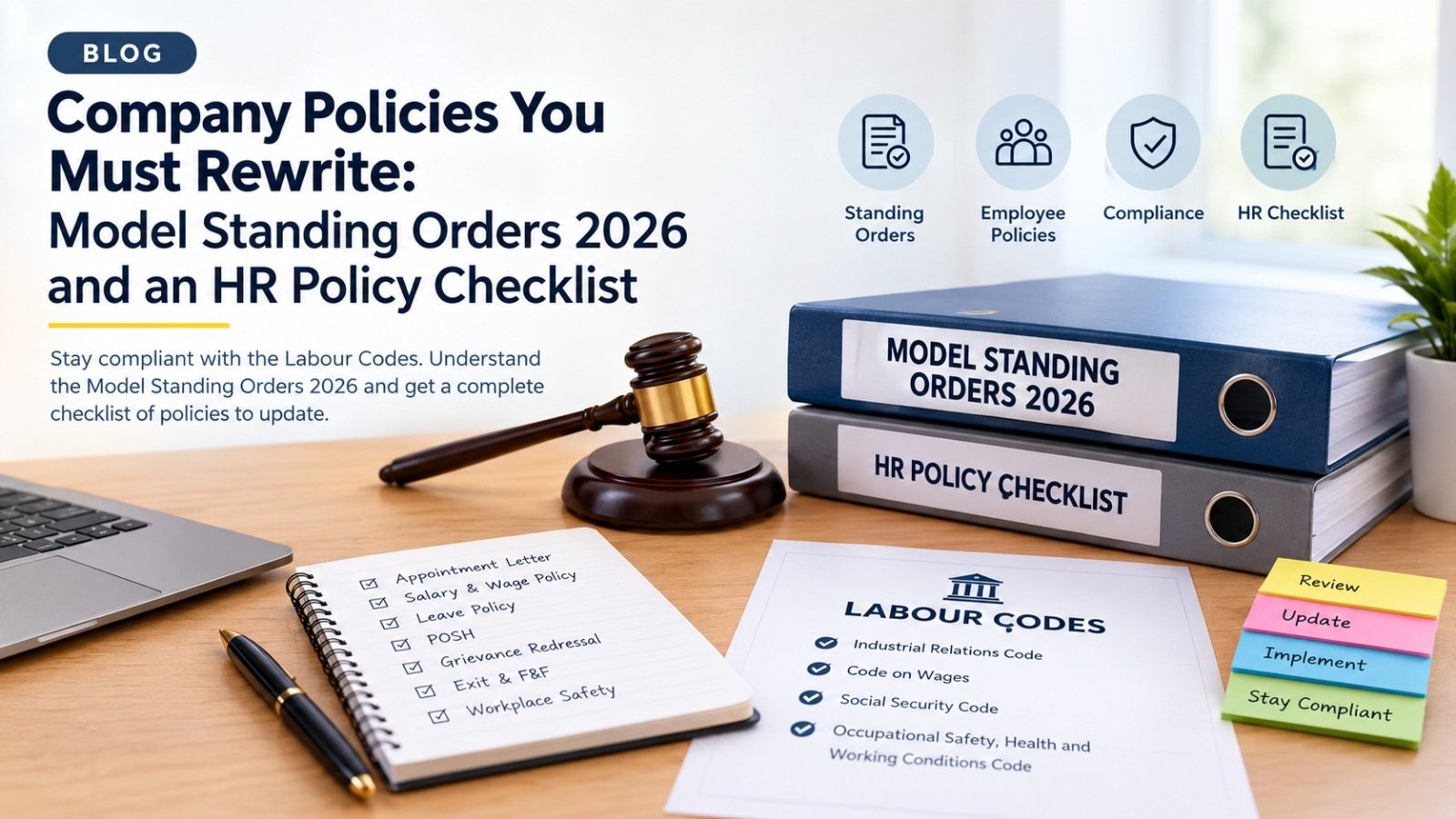
Model Standing Orders 2026: HR Policy Checklist for Companies
Most Indian companies run on a mix of offer letters, a handbook, email circulars and habit. The Labour Codes narrow the room for habit. The Ministry of Labour and Employment issued Model Standing Orders, 2026 on 8 May 2026 under Section 29(1) of the Industrial Relations Code, with separate schedules for mining, manufacturing and services. Your policies should now be read against them.
Read this first. The requirements below should be checked against the applicable Central and State Rules, the relevant Model Standing Orders, and the official notifications. Applicability and specific provisions may vary by establishment and category of worker.
1. Who needs standing orders?
Under the Central Rules described in this article, standing orders apply to establishments with 300 or more workers. Such an establishment can either adopt the Model Standing Orders or draft its own standing orders for certification, as applicable under Rule 10.
Smaller employers may not be subject to the same standing orders requirements. However, the Model Standing Orders can still serve as a useful benchmark when preparing a clear, consistent and legally defensible employee handbook.
2. What the Model Standing Orders say
| Topic | Provision |
|---|---|
| Probation | Worker becomes permanent after 6 months; periods lost to leave, accident, strike or lockout still count; extension of up to 3 months on performance. |
| Casual leave | Up to 10 paid days a year, generally in blocks of no more than 3 days. |
| Leave applications | At least 7 days in advance; written reasons if leave is refused or postponed. |
| Shift change | 21 days' notice to affected workers, plus unions where applicable. |
| Suspension | 50% of wages for the first 90 days, and 75% thereafter if the delay is not attributable to the employee. |
| Appeal | Appeal against disciplinary penalties within 21 days. |
| Closure | Pending wages cleared within 2 working days. |
| Fixed-term employment | Parity of wages, hours, allowances and statutory benefits with permanent workers; gratuity after 1 year, subject to applicable law; contract expiry is not retrenchment. |
| Misconduct | Theft, insubordination, habitual absenteeism, intoxication, sabotage, illegal strikes, assault, falsification of records, refusal to use safety equipment, and sexual harassment. |
The Central Rules also describe requirements for covered establishments to display working hours, shifts, holidays, pay days and wage rates in Hindi, English and the local language; maintain a transfer policy on the HR portal; keep a service record for each worker; and conduct an initial medical examination.
Work-from-home requirements should be reviewed separately against the applicable legislation, rules and official notifications. Do not assume that the Model Standing Orders expressly cover every remote-working arrangement without checking the relevant text.
3. The policy checklist
Use the following checklist to identify the policies that may need review under the Labour Codes, applicable rules and Model Standing Orders.
| Policy | Must address |
|---|---|
| Appointment letter | Prescribed format, labour identification number, UAN and wage structure, where required under the applicable OSH Rules. |
| Salary and wage policy | 50% wage rule, pay dates and wage slip in Form V, subject to the applicable Code and Rules. |
| Deduction policy | 50% monthly deduction cap and a 7-day explanation period before deductions for damage or loss, where applicable. |
| Fixed-term employment | Parity with permanent staff, gratuity eligibility and the treatment of contract expiry under applicable law. |
| Probation and confirmation | 6-month probation and an extension of up to 3 months, subject to the applicable Model Standing Orders. |
| Leave policy | Casual, earned, sick and maternity leave; notice requirements; and written reasons for refusal where required. |
| Attendance and working hours | Applicable daily and weekly working-hour limits, rest days and substitute rest days. |
| Overtime | Applicable double-rate payment, quarterly limits and written approval requirements. |
| Night shift (women) | Consent, transport arrangements and emergency contact numbers, in accordance with applicable law. |
| Creche and nursing | Applicable creche facilities, any prescribed allowance and nursing breaks, as required by the relevant rules. |
| Disciplinary and misconduct | Show-cause notices, inquiry procedures, employee representation, subsistence allowance and appeal timelines. |
| POSH | Internal Committee where required, statutory complaint procedures and annual reporting obligations. |
| Grievance redressal | A documented complaint-handling process, responsible persons and applicable resolution timelines. |
| Exit and full and final settlement | Applicable wage-payment deadlines, clearance workflow and gratuity payment timelines. |
| Transfer | A published transfer policy where required for covered establishments. |
| Data and records | Digital registers, record-retention periods, access controls and statutory documentation. |
| Safety and health | Applicable OSH requirements and prescribed health examinations for notified categories of workers. |
4. How to roll out new policies without a revolt
- Draft policies against the applicable Model Standing Orders and State Rules.
- Arrange a legal review to identify state-specific requirements and exceptions.
- Consult managers and, where applicable, the union or worker representatives.
- Publish the policies in English and the relevant local language, using the HR portal where appropriate.
- Collect employee acknowledgements electronically or in writing and retain the records.
- Train managers first so they can explain the revised policies consistently.
- Review policies annually or whenever a relevant legal amendment or notification is issued.
5. Mistakes to avoid
- Copy-pasting a template without matching it to the applicable State Rules.
- Allowing the offer letter to contradict the employee handbook.
- Changing a service condition without following the required notice and consultation procedures.
- Publishing a policy that employees cannot easily find or access.
- Applying a policy inconsistently, increasing the risk of disputes and disciplinary challenges.
Frequently Asked Questions (FAQs)
The Model Standing Orders, 2026 set out workplace rules concerning employment conditions, probation, leave, working hours, disciplinary procedures and employee misconduct for establishments covered by the applicable law. Employers should consult the relevant schedule and official notification to determine which provisions apply to their operations.
Under the requirements described in this article, establishments with 300 or more workers may be subject to the applicable Standing Orders requirements. Eligible establishments may adopt the Model Standing Orders or prepare their own standing orders for certification, as required by the applicable law and rules.
Companies should review appointment letters, salary and wage policies, leave and attendance policies, overtime, fixed-term employment, disciplinary procedures, POSH, grievance redressal, exit procedures, transfer policies, employee records and workplace safety policies.
Companies can implement updated policies by reviewing applicable labour laws, obtaining legal advice, consulting relevant stakeholders, publishing policies in appropriate languages, collecting employee acknowledgements, training managers and reviewing the policies regularly.
Conclusion
A policy is only as effective as its implementation. If your employee handbook and actual workplace practices differ, your organisation may face compliance risks and disciplinary disputes. Review your policies against the applicable Labour Codes, Model Standing Orders and State Rules, and make sure that managers and employees understand how those policies work in practice.